On this World Water Day, I have the pleasure to send my best wishes firstly to all the people and organizations who work to give clean water to those who are not entitled to their right to water and then to the whole world to wish them a Happy World Water Day.
World Water Day was recommended at the 1992 United Nations Conference on Environment and Development (UNCED) in Rio de Janeiro and in 1993, the United Nations General Assembly welcomed that idea by designating 22 March 1993 as the first World Water. Since, as we remember, World Water Day has become an international observance and an opportunity to mobilize the world about water related issues and to take actions that make a difference.
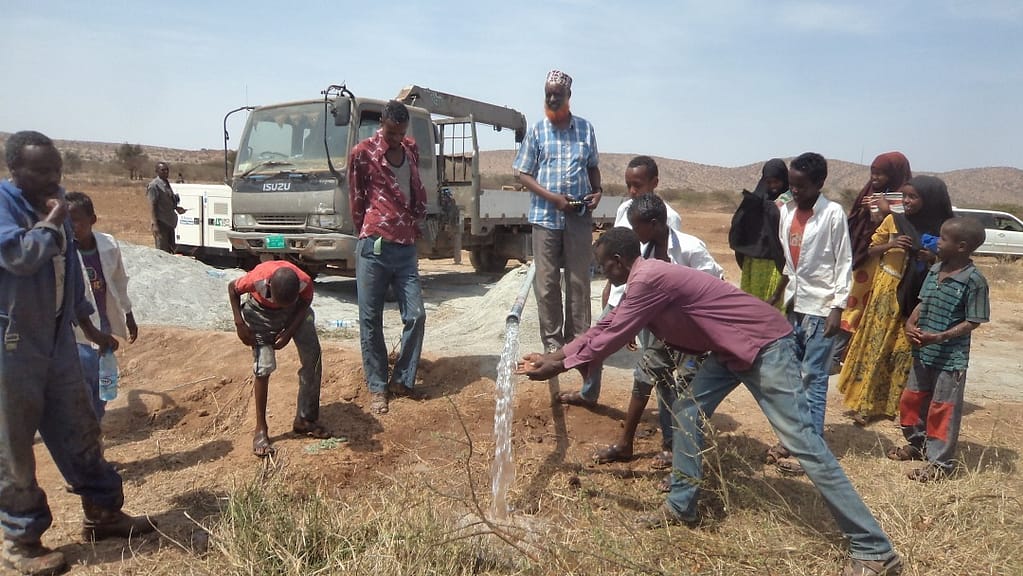
Hillsan International joins all the goodwill who today celebrate the world water day to contribute its voice to the call for action to correct the dramatic situation concerning water.
We believe that Water is an essential commodity for life. Without water life is threatened, with the result being death. The right to water is thus an inalienable right.
A major achievement of recent history has been the ability to elaborate, within the framework of the United Nations, a network of international instruments formally identifying and proclaiming a broad spectrum of universally recognized human rights.
The Resolution 64/292 published by the United Nations General Assembly explicitly recognized this right by declaring that sufficient and safe drinking water is a precondition for the realization of other human rights. It is argued that water was so fundamental a resource that, just as a right to air was not identified, water was not explicitly mentioned at the time the fundamental human rights documents were drawn up but was understood as a given which the drafters implicitly included. Furthermore, several of the explicit rights protected by conventions and agreements, such as rights to food, clothing, housing and medical care and necessary social services, cannot be attained or guaranteed without also guaranteeing access to clean water (Kyoto Conference).
Clean, accessible water is critical to human health, a healthy environment, poverty reduction, a sustainable economy, and peace and security. Yet over 40% of the global population does not have access to sufficient clean water. By 2025, 1.8 billion people will be living in countries or regions with absolute water scarcity, according to UN-Water. The lack of water poses a major threat to several sectors, including food security.
According to the latest estimates of the WHO/UNICEF Joint Monitoring Programme for Water Supply and Sanitation (JMP), 32 per cent of the world’s population – 2.4 billion people – lacked improved sanitation facilities, and 663 million people still used unimproved drinking water sources in 2015 Inadequate access to safe water and sanitation services, coupled with poor hygiene practices, kills and sickens thousands of children every day, and leads to impoverishment and diminished opportunities for thousands more.
Without a shadow of a doubt, Africa is the continent most affected by water scarcity and its consequences. According to data published in 2003, this Continent will experience the largest population increase projected in the world (+ 50% in the next 15 years) and a powerful movement of urban concentration, this continent is therefore facing a major change, while his current situation is already more than precarious.
The water services in many developing countries are however still plainly inadequate in providing safe water supplies. This situation is so dramatic that it will not be overcome without increased development assistance and focused private investment from abroad. Many people must confront daily the situation of an inadequate supply of safe water and the very serious resulting consequences. So, it is important to know that Water is not only a technical problem. Before being a technical problem, water is primarily a social, political, economic and environmental issue. It is also in Africa a vital stake whose scale is hard to appreciate.
Water-related diseases are one of the world’s most serious health problems, which however, to a large extent, could be avoided. Cholera and other diarrheal diseases are responsible for 1.8 million deaths per year. The poorest people in developing countries, especially children, suffer the most. Water-related diseases keep millions of people in a vicious circle of poverty and poor health, making them unable to work or go to school. Also, according to UNICEF, poor sanitation, water and hygiene have many other serious repercussions.
Because of lack of water in most developing countries, children specially girls are denied their right to education because their schools lack private and decent sanitation facilities. Girls are forced to spend large parts of their day fetching water. We found this problem in a rural village named Buss north of Gabiley in Somaliland where several girls were forced to leave school for domestic work such as fetching water twice a day.
Preventing girls from going to school has serious consequences for each of them, but also for the development of their community and their country. It perpetuates poverty while increasing inequality between boys and girls. Keeping girls out of school keeps them in their inferior status to men. A girl who does not go to school will have a harder time making her voice heard. She will not be able to participate actively in the decisions of the society in which she lives. Girls’ lack of education does not allow them to escape poverty. This situation may be perpetuated in the next generation because an uneducated girl cannot understand the value of giving her children a quality education. Yet it has been established that every year a girl goes to school, her future income increases by 10 to 20 percent.
That said, it seems to me that we must change the way we understand the problem. We must not lose sight of the fact that this is, after all, a matter of human rights.
Respect for life and the dignity of the human person must be the ultimate guiding norm for all development policy, including environmental policy. The central point of convergence of all issues pertaining to development, the environment and water must be the human person. The priority of every country and the international community for sustainable water policy should be to provide access to safe water to those who are deprived of such access at present because water is such a common good of humankind. Priority should be given to the rural poor people, because we know that even NGOs and governments concentrate most of their time and resources in urban areas. The few with the means to control, must not destroy or exhaust this resource, intended for the use of all.
In a globalized world, the water concerns of the poor must become the concerns of all in a perspective of solidarity. This solidarity must be on the part of every individual a firm and persevering commitment to the commitment for the common good, for the good of all. This is the necessary effort for a more just social order and preferential attention to the situation of the poor. This solidarity should also exist between developed and developing countries.
That’s why Hiilsan International Rural Development focuses on rural areas for the simple reason that the poorest people live there. And these poor people lack everything starting with clean water, health centers and schools not to mention chronic food insecurity.
Seen from the commercial point of view, Africa is already an Eldorado for many companies and will remain so. From a human perspective, Africa is a continent where suffering and misery continue to grow. How long will the African people accept all these inequalities?
Poverty is about people and their ability to realize their God-given potential. The poor show extraordinary creativity in seeking means of survival in the absence of adequate services. This creativity is a resource which should not be overlooked in working together to build up sustainable communities and avoid the creation of dependence. This is our goal as an organization.
Happy World Water Day
Ali H Hersi
Recent Comments